 Bovada Bot Research
How anonymous tables wreck the bot data pipeline — my read
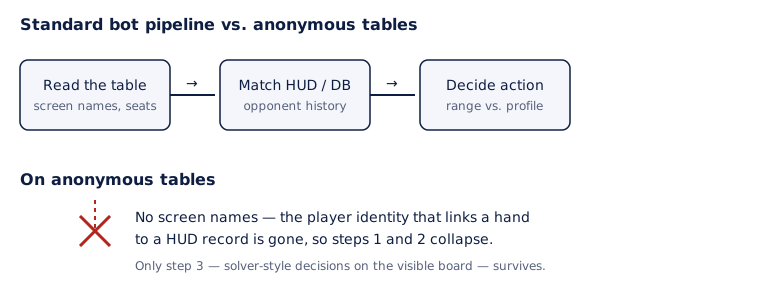
In one paragraph. A conventional poker bot works as a pipeline: read the table, match each opponent to a stored history, then choose an action against that opponent's tendencies. Bovada's anonymous tables sever the first two links. With no persistent screen name, there is nothing to key a database record to, so HUDs and tracking software return empty. Only the last link — making a decision against the visible board and bet sizes — still functions, and that is the weakest, least profitable part of the chain.
What "anonymous" actually means here
On a tracked poker site, every seat carries a username that persists across sessions. That single identifier is the hook everything else hangs on: hand-history importers tag hands to it, databases accumulate statistics under it, and a heads-up display surfaces those stats in real time. Anonymous tables remove the hook. Seats are unlabeled or carry throwaway position markers, and the same opponent next orbit is, as far as any tool can tell, a stranger.
This is a deliberate design choice. Bovada markets anonymity as recreational-player protection — it stops sharks from building target lists of weak regulars. The side effect is that it also starves automation of the inputs it was built to consume.
The three removals, and why each one bites
1. No persistent screen names
Without a username, there is no primary key. A bot can still observe a hand in progress, but it cannot say "this is the same loose-passive player I tagged forty hands ago." Every decision is made against an unknown distribution. Exploitative play — the entire reason opponent profiling exists — becomes impossible, and the agent is forced into a static strategy.
2. No working HUD
A heads-up display is only as good as the database behind it. Point a HUD at an anonymous table and the stat boxes stay blank because there are no historical hands to aggregate per opponent. The real-time edge a HUD provides — VPIP, PFR, aggression frequency on the player you are about to face — simply does not populate.
3. No importable hand histories that map to opponents
Some anonymous rooms still let you export your own hands, but the opponent fields are anonymized or rotated, so the histories cannot be stitched into a longitudinal profile of any specific player. Post-session study of your own play is possible; building a population read on named villains is not.
| Input a bot normally uses | Tracked site | Bovada anonymous table |
|---|---|---|
| Persistent opponent ID | Available | Absent |
| Real-time HUD stats | Populated | Empty |
| Historical opponent database | Builds over time | Never accumulates |
| Board, pot, bet sizing | Available | Available |
| Own timing & cadence | Visible to operator | Visible to operator |
What survives
Only the board-facing decision remains intact. A bot can still read the community cards, the pot, and the bet sizes in front of it, and run those through a solver or a fixed strategy. That produces competent-but-undifferentiated play: reasonable against the field on average, exploitable by nobody-in-particular and exploiting nobody-in-particular. The profit that comes from punishing specific weak players is gone, because the identity of those players is gone.
Why this matters before you trust any tool
If a product claims a Bovada edge built on "reading your opponents" or "adaptive opponent modeling," the architecture of the room makes that claim hard to support — the per-opponent data it would require is not exposed. The honest conversation about automation on anonymous rooms is narrower and lives one layer down, in behavior and timing. That is the subject of the companion analysis on what automation can still do.
Have a technical question about anonymous rooms?
If you are researching how automation behaves without opponent data, the team can walk through the specifics.
Contact the team
Poker Software Expert