 Bovada Bot Research
What automation can still do — and where I think detection moves
In one paragraph. On Bovada's anonymous tables, automation is reduced to board-based decision-making: a fixed or solver-style strategy applied to the visible cards, pot, and bet sizes, with no opponent profiling. Because the player-side data that detection tools used to scan is gone, integrity enforcement does not disappear — it relocates server-side. The operator analyzes timing, session cadence, input biometrics, and win-rate footprints, which the anonymous lobby has no effect on. Anonymity hides players from each other; it does not hide them from the server.
The narrow band of automation that survives
Stripped of opponent memory, an automated agent can still do exactly one useful thing: compute a reasonable action for the current spot. Given the board, the pot odds, and the bet it faces, it can apply a precomputed strategy and act. This is real, but it is also the commodity layer of poker AI — equity and game-theory baselines are well understood and widely available. The hard, profitable part has always been adaptation to specific opponents, and that part is dead on anonymous tables.
The practical consequence: an agent here plays like a disciplined, slightly predictable regular. It will not spew, but it also will not extract the outsized value that comes from hammering identified weak players. Its expected win rate is thin, and thin edges are exactly what behavioral monitoring is best at catching over volume.
Detection does not vanish — it moves
A common misconception is that anonymity protects bots as much as it protects recreational players. It does not. Anonymity only blinds other players. The operator still records every event on its own servers, and that server-side stream is where modern detection lives.
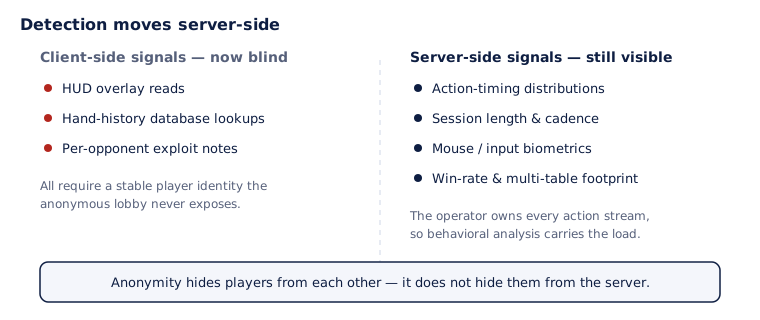
What the server still sees
- Action timing. Humans show variable, context-dependent decision times. Bots tend toward suspiciously tight or suspiciously uniform timing distributions, which stand out across thousands of decisions.
- Session cadence. Marathon sessions, robotic break patterns, and 24/7 availability are statistical flags.
- Input biometrics. Mouse paths, click jitter, and focus behavior differentiate a person from a script far more reliably than card decisions do.
- Win-rate and table footprint. A steady, mechanical win rate spread across many simultaneous tables is a classic signature.
None of these depend on knowing who the player is at the table. They depend on the account and the device, both of which the operator owns end to end. So the same anonymity that disables a bot's exploitative edge leaves the operator's detection surface fully intact.
Why this reframes the whole question
On a tracked site the bot arms race is partly about out-reading opponents. On Bovada it is almost entirely about looking human to the server while accepting a thin, board-based edge. That is a harder engineering problem and a worse risk-reward trade, which is why blunt "plug-and-play Bovada bot" claims rarely survive contact with how the room actually works. For the mechanics of why the opponent data is missing in the first place, see the breakdown of how anonymous tables work.
Researching detection-aware automation?
If you want to talk through the server-side realities of anonymous rooms, the team is happy to go deeper.
Contact the team
Poker Software Expert